GoHighLevel vs. Zapier: 2026 Review Recovery, Booking Save-backs & Reputation Loops
A July 28, 2026 comparison of GoHighLevel and Zapier for review recovery, no-show booking save-backs, reputation-to-revenue loops, and frontline service recovery ops.
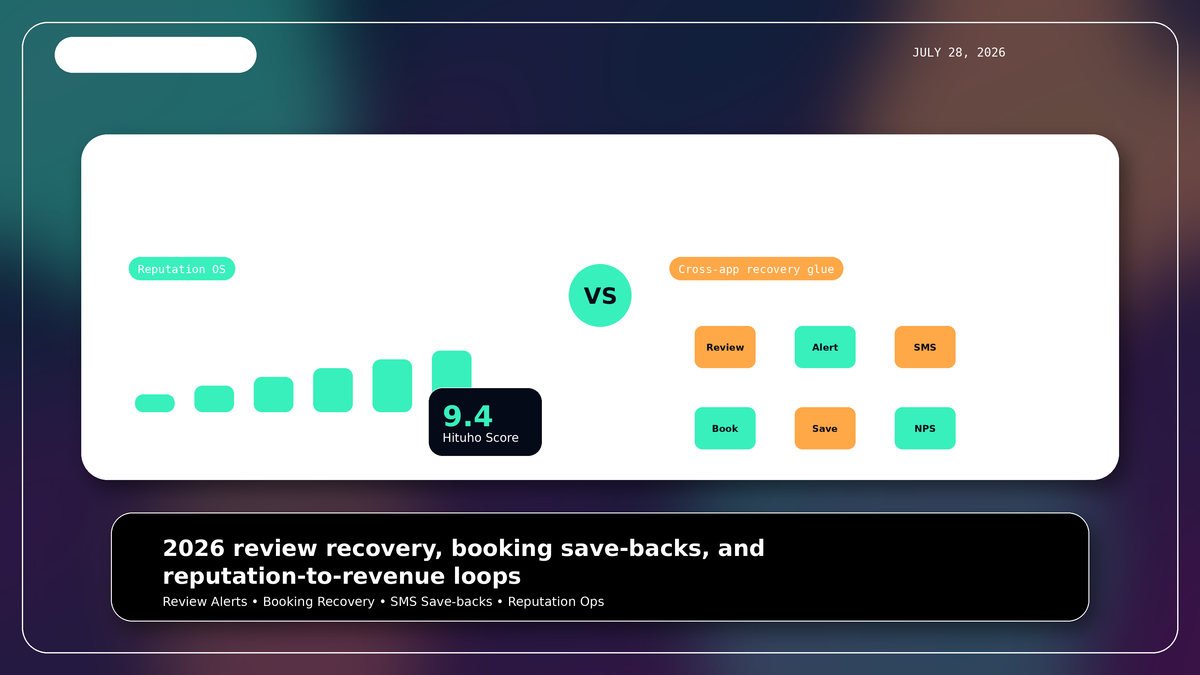
Bottom line: choose GoHighLevel when the product is a packaged reputation-to-booking recovery system—review alerts, no-show rescue, rebooking offers, and local CRM under one brand surface. Choose Zapier when each recovery step depends on specialized tools headquarters cannot force into a single service OS.
TL;DR for July 28, 2026: service operators no longer buy automation only for lead gen. They buy systems that catch bad reviews fast, save abandoned bookings, rebook no-shows, and prove which recovery path protected revenue without five partial truths.
What service operators actually buy in 2026
Local service, clinic, home services, and multi-location operators evaluate platforms by recovery speed and ownership clarity, not demo polish. The real questions are operational: Who sees a one-star review first? Can a no-show be rebooked in minutes? Does the same contact record own the complaint, the SMS save-back, and the follow-up offer? Can managers prove which location recovered reputation and revenue this week?
GoHighLevel answers those questions with a frontline commercial OS: calendars, messaging, review request workflows, pipelines, and contact ownership that can run as a repeatable recovery playbook. Zapier answers them with integration leverage: connect Google reviews, Square/Toast, Calendly, Zendesk, Stripe, and regional CRMs so specialized tools still talk when a customer is about to churn.
Core model: reputation OS vs recovery glue
| Decision layer | GoHighLevel (July 2026) | Zapier (July 2026) |
|---|---|---|
| Operator surface | One console for contacts, SMS, bookings, and review follow-up | Many destination UIs after each automation hop |
| Review recovery | Strong when brand owns request timing, alerts, and reply playbooks | Strong when Google/Yelp/support tools must stay separate but coordinated |
| Booking save-backs | Native calendars + SMS/email sequences close to the contact record | Excellent for bridging external booking, POS, and payment systems |
| Speed to package | Excellent once recovery snapshots and SOPs are mature | Excellent for workflow templates across heterogeneous apps |
| Failure mode | Edge-tool politics when franchisees keep separate review stacks | Opaque multi-app spaghetti and unclear who owns the save-back |
When GoHighLevel wins for review and booking recovery
GoHighLevel is the better default for clinics, home services, dental, beauty, and multi-location service brands that need operators to act inside one system. The advantage is not a longer connector list. It is that the same contact can move from review alert → private recovery SMS → rebooking offer → pipeline stage without the front desk hopping tools.
- Review request + rescue loops: ask happy customers for public reviews, intercept unhappy ones privately, and keep both paths on one contact record.
- No-show and abandoned booking recovery: trigger SMS/email save-backs from calendars and pipelines instead of relying on memory or sticky notes.
- Operator density: give location staff one place for messages, appointments, notes, and recovery offers.
- Cloneable reputation SOPs: package request timing, reply templates, and rebooking offers as snapshots for new locations.
- Revenue-linked reputation: connect review outcomes to rebooking and pipeline stages so managers can measure more than star averages.
The tradeoff is strategic fit. If Google Business Profile, POS refunds, enterprise calendars, or support desks already own critical recovery steps, forcing everything into GoHighLevel can create dual systems and staff resistance.
When Zapier is the better recovery fabric
Zapier is the better default when the service stack is paid to connect systems, not replace them. Many operators look like this: Google reviews → POS → booking app → support desk → SMS gateway → billing. Zapier is designed for that heterogeneous reality.
- Best-of-breed recovery stacks: keep Google Business Profile, Square, Toast, Calendly, Zendesk, or regional CRMs without forced consolidation.
- Cross-system exception handling: route one-star alerts, refund thresholds, no-show events, and SLA breaches across tools HQ does not fully host.
- Market-by-market branching: branch by location, brand tier, or complaint severity before a human is paged.
- Incremental packaging: productize one recovery workflow family at a time without re-platforming frontline ops.
- Finance + service glue: connect refunds, credits, and rebooking offers across billing and support tools.
The risk is operational fog. If reviews live in one app, bookings in another, refunds in a third, and SMS in a fourth, no one can prove which recovery step failed when a location bleeds five-star share or rebooking revenue.
Practical comparison for service recovery operators
| Operator question | Prefer GoHighLevel | Prefer Zapier |
|---|---|---|
| What are you standardizing? | A packaged reputation + booking recovery OS | Integration and multi-app exception design |
| Where does the contact live? | Close to SMS, calendar, pipeline, and review follow-up | Across Google, POS, support, and booking apps |
| Who acts on Saturday night? | Frontline staff inside one operator console | Whoever owns the destination app that received the alert |
| How similar are locations? | Highly similar recovery playbooks and offers | Highly different regional stacks and compliance constraints |
| What fails first at scale? | Edge-tool lock-in politics and dual systems | Zap sprawl, naming chaos, and unclear ownership |
A clean 2026 service recovery decision framework
Use three tests before standardizing the reputation and booking stack:
- Alert-to-action test: can a bad review or no-show reach an owner with a clear next step in minutes?
- Single-record test: after recovery, does one contact record show the complaint, the save-back, and the rebooking outcome?
- Manager proof test: can HQ show which locations recovered reputation and revenue without exporting five CSVs?
If those three tests pass more easily inside one commercial OS, GoHighLevel is the answer. If they only pass when many specialized service systems stay connected, Zapier is the answer.
Final recommendation
For July 28, 2026 service buyers, GoHighLevel is the stronger choice when review recovery, booking save-backs, and reputation-to-revenue loops need one owner. Zapier is the stronger choice when reviews, POS, support, and billing must reason across a modular stack the brand does not fully control.
Many mature multi-location operators run both with hard boundaries: GoHighLevel owns packaged frontline recovery and local CRM delivery; Zapier owns Google/POS/support exceptions and non-standard regional systems. That hybrid only works when every location has an explicit system of record and dual-write paths are banned.
Editorial disclosure: This article contains affiliate links. If you click and subscribe, Hituho may earn a commission at no extra cost to you. Recommendations are based on recovery speed, ownership clarity, booking reliability, and practical multi-location service ops value.