GoHighLevel vs. Zapier: 2026 Agency White-label, Sub-accounts & Client Billing
A July 26, 2026 comparison of GoHighLevel and Zapier for agency sub-accounts, white-label client delivery, SaaS packaging, and multi-client billing operations.
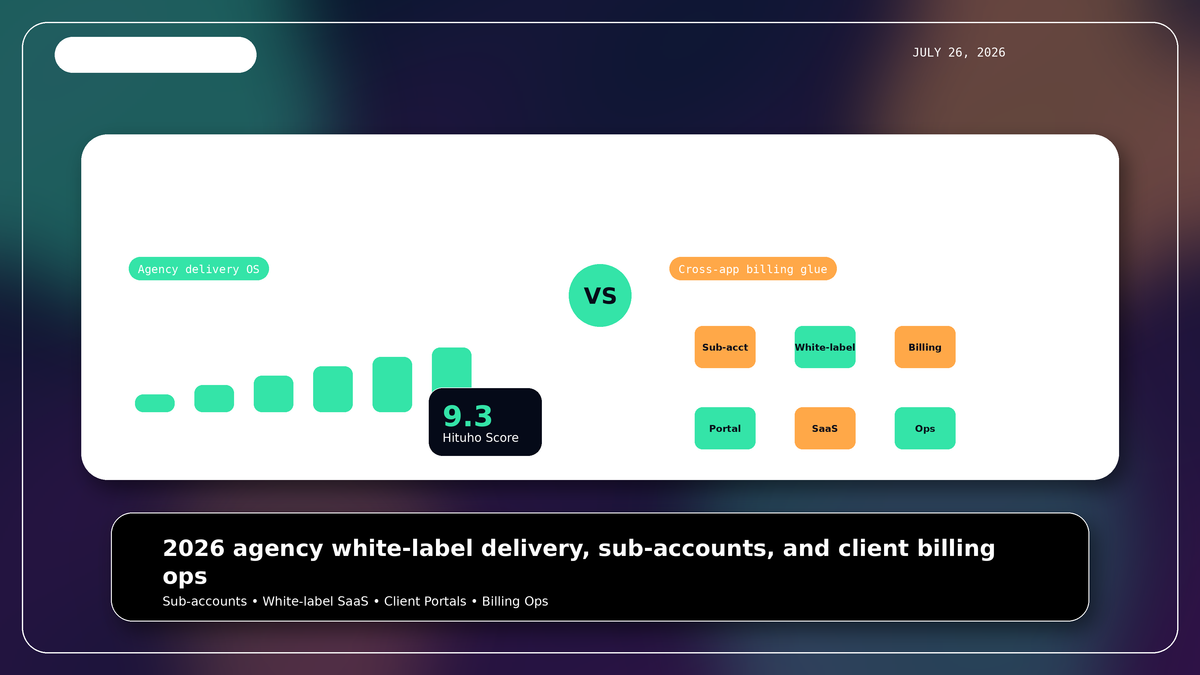
Bottom line: choose GoHighLevel when the agency product is a repeatable client delivery system—sub-accounts, white-label portals, messaging, and revenue workflows under one brand. Choose Zapier when client work depends on many external systems that cannot be forced into a single agency OS.
TL;DR for July 26, 2026: agencies no longer buy tools only for internal automation. They buy systems that can package, bill, deliver, and scale client outcomes without rebuilding every onboarding path from scratch.
What agencies actually buy in 2026
Agency buyers now evaluate platforms by client replication cost, not feature demos. The real questions are operational: How fast can a new client sub-account spin up? Can the agency rebrand the experience? Where does billing live? Who owns fulfillment after the invoice clears? Can the same operator run twenty accounts without twenty unique stacks?
GoHighLevel answers those questions with a productized commercial OS: sub-accounts, snapshots, white-label SaaS modes, CRM, calendars, messaging, funnels, and portals in one package. Zapier answers them with integration leverage: connect Stripe, QuickBooks, Notion, Google Workspace, Slack, CRMs, support desks, and custom APIs so each client stack can stay specialized while ops still scale.
Core model: client delivery OS vs multi-app glue
| Decision layer | GoHighLevel (July 2026) | Zapier (July 2026) |
|---|---|---|
| Client packaging | Native sub-accounts, snapshots, and white-label packaging | Depends on how well destination apps can be templated |
| Billing ownership | Strong when agency sells GHL-centered services or SaaS | Strong when invoices, renewals, and payouts span many finance tools |
| Delivery surface | One operator console for CRM, messaging, funnels, and portals | Many destination UIs after each automation hop |
| Replication speed | Excellent once snapshots and SOPs are mature | Excellent for workflow templates, weaker for full client UX packaging |
| Failure mode | Client stack lock-in and edge-tool exceptions | Hidden integration debt and unclear ownership across apps |
When GoHighLevel wins for agency delivery
GoHighLevel is the better default for agencies, consultants, and micro-SaaS operators who sell a standardized growth system. The advantage is not a longer feature list. It is that onboarding, client branding, contact ownership, appointment booking, messaging, and reporting can live inside one commercial surface that can be cloned.
- Sub-account replication: launch new clients from snapshots instead of rebuilding CRM fields, pipelines, and funnels every time.
- White-label packaging: present the system under the agency brand when the product itself is part of the offer.
- Operator density: let one team manage many clients without context-switching across twenty admin panels.
- Revenue adjacency: keep leads, appointments, invoices, and follow-up close enough for service and SaaS hybrids.
- Productized SOPs: turn delivery into a system with fewer custom one-off builds per client.
The tradeoff is strategic fit. If a client already has a mature CRM, finance stack, support desk, or product backend, forcing everything into GoHighLevel can create dual systems and political friction.
When Zapier is the better multi-client ops fabric
Zapier is the better default when the agency is paid to connect systems, not replace them. Many retainers now look like this: form tools → CRM → billing → project management → support → reporting warehouse. Zapier is designed for that multi-system reality.
- Best-of-breed client stacks: keep Salesforce, HubSpot, Xero, Stripe, Asana, Intercom, or Sheets without forced consolidation.
- Billing complexity: route invoices, renewals, refunds, usage events, and payouts across finance and ops tools.
- Exception handling: branch by client tier, SLA, region, or product line before a human is paged.
- Incremental packaging: productize one workflow family at a time without re-platforming every client.
- Internal + external glue: connect agency ops tools and client tools in the same automation layer.
The risk is delivery fog. If onboarding lives in one app, billing in another, messaging in a third, and reporting in a fourth, no one can prove which client process failed or who owns the fix.
Practical comparison for agency operators
| Operator question | Prefer GoHighLevel | Prefer Zapier |
|---|---|---|
| What are you selling? | A packaged growth OS, retainer system, or white-label SaaS | Integration, orchestration, and multi-app process design |
| How similar are clients? | Highly similar delivery patterns and packages | Highly different stacks and compliance constraints |
| Who owns the client UI? | Agency-controlled portal and sub-account experience | Destination apps already used by the client team |
| Where does billing live? | Close to CRM, services, and follow-up inside one OS | Across Stripe, accounting, ERP, and custom finance tools |
| What fails first at scale? | Edge-tool exceptions and lock-in politics | Zap sprawl, naming chaos, and unclear ownership |
A clean 2026 agency decision framework
Use three tests before standardizing the agency stack:
- Replication test: can a new client be launched in hours with consistent branding, pipelines, and SOPs?
- Billing-to-delivery test: after payment clears, does fulfillment start without manual copy-paste between finance and ops?
- Ownership test: if a client process breaks at 9pm, is there one system of record or five partial truths?
If those three tests pass more easily inside one commercial OS, GoHighLevel is the answer. If they only pass when many specialized systems stay connected, Zapier is the answer.
Final recommendation
For July 26, 2026 agency buyers, GoHighLevel is the stronger choice when white-label delivery, sub-accounts, and productized client operations need one owner. Zapier is the stronger choice when multi-client billing and fulfillment must reason across a modular stack the agency does not fully control.
Many mature agencies run both with hard boundaries: GoHighLevel owns packaged client delivery and frontline revenue ops; Zapier owns finance exceptions, niche tools, and non-standard client systems. That hybrid only works when every client has an explicit system of record and dual-write paths are banned.
Editorial disclosure: This article contains affiliate links. If you click and subscribe, Hituho may earn a commission at no extra cost to you. Recommendations are based on agency packaging speed, ownership clarity, billing-to-delivery reliability, and practical multi-client ops value.