GoHighLevel vs. Zapier: 2026 Franchise Multi-location Control & HQ Playbooks
A July 27, 2026 comparison of GoHighLevel and Zapier for franchise multi-location rollouts, HQ playbooks, store-level CRM ownership, and cross-location operations.
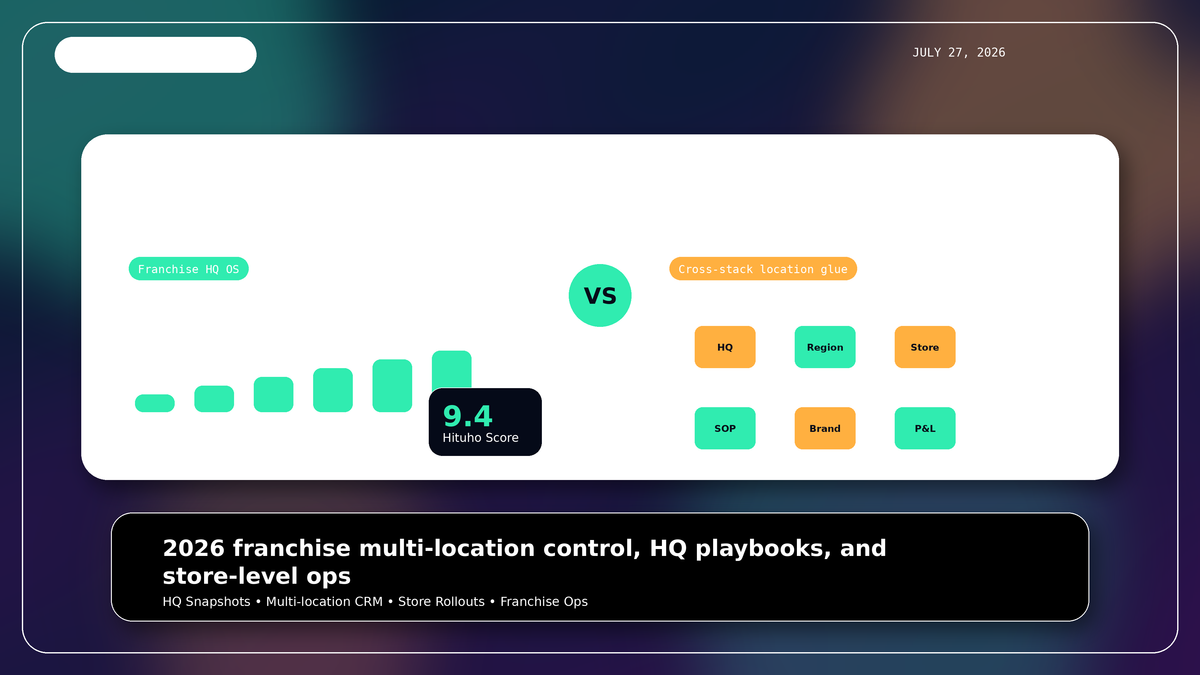
Bottom line: choose GoHighLevel when the franchise product is a repeatable location operating system—HQ playbooks, store sub-accounts, local booking, messaging, and lead ownership under one brand. Choose Zapier when each location depends on specialized regional tools that headquarters cannot force into a single franchise OS.
TL;DR for July 27, 2026: franchise operators no longer buy tools only for lead gen. They buy systems that can roll out stores, enforce brand SOPs, preserve local ownership, and keep HQ reporting clean without rebuilding every location from scratch.
What franchise operators actually buy in 2026
Franchise buyers evaluate platforms by rollout cost and control quality, not demo polish. The real questions are operational: Can HQ push a proven playbook to a new store in hours? Who owns local contacts and reviews? How do regional managers see pipeline without breaking franchisee autonomy? Can payroll, POS, inventory, and marketing stay connected without dual-entry?
GoHighLevel answers those questions with a franchise-ready commercial OS: location sub-accounts, snapshots, calendars, messaging, funnels, and reporting that can be templated from HQ. Zapier answers them with integration leverage: connect Toast, Square, NetSuite, ADP, regional CRMs, review platforms, and support desks so each market can keep specialized systems while HQ still orchestrates exceptions.
Core model: franchise OS vs multi-location glue
| Decision layer | GoHighLevel (July 2026) | Zapier (July 2026) |
|---|---|---|
| Location packaging | Native sub-accounts and HQ snapshots for store replication | Depends on how well destination apps can be templated per market |
| HQ control | Strong when brand owns playbooks, CRM fields, and local delivery UI | Strong when HQ must enforce logic across tools it does not host |
| Local ownership | One operator console per location for CRM, messaging, and booking | Many destination UIs after each automation hop |
| Rollout speed | Excellent once franchise snapshots and SOPs are mature | Excellent for workflow templates, weaker for full location UX packaging |
| Failure mode | Franchisee lock-in politics and edge-tool exceptions | Hidden integration debt and unclear ownership across regional stacks |
When GoHighLevel wins for franchise multi-location
GoHighLevel is the better default for franchise brands, multi-location service companies, and regional operators who sell a standardized local growth system. The advantage is not a longer feature list. It is that store onboarding, brand messaging, contact ownership, appointment booking, review requests, and HQ visibility can live inside one commercial surface that can be cloned.
- HQ snapshot rollouts: launch new locations from approved playbooks instead of rebuilding pipelines, forms, and follow-up every time.
- Location sub-accounts: keep store-level CRM ownership while preserving brand structure and reporting hierarchy.
- Local delivery surface: put booking, SMS/email follow-up, funnels, and reputation workflows in one place franchisees can actually run.
- Operator density: let regional managers supervise many stores without twenty different admin panels per market.
- Productized franchise SOPs: turn brand standards into a system with fewer custom one-off builds per territory.
The tradeoff is strategic fit. If franchisees already have mature POS, payroll, inventory, or compliance systems, forcing every local process into GoHighLevel can create dual systems and political friction with owners who value autonomy.
When Zapier is the better multi-location ops fabric
Zapier is the better default when the franchise network is paid to connect systems, not replace them. Many multi-location orgs look like this: local POS → inventory → payroll → regional CRM → review platforms → HQ data warehouse. Zapier is designed for that heterogeneous reality.
- Best-of-breed location stacks: keep Toast, Square, NetSuite, ADP, Zendesk, or regional CRMs without forced consolidation.
- Cross-system franchise logic: route new store events, refunds, staffing thresholds, review alerts, and SLA breaches across tools HQ does not fully own.
- Exception handling by market: branch by region, brand tier, franchisee maturity, or compliance zone before a human is paged.
- Incremental packaging: productize one franchise workflow family at a time without re-platforming every store.
- HQ + franchisee glue: connect corporate ops tools and local owner tools in the same automation layer.
The risk is operational fog. If store leads live in one app, POS in another, payroll in a third, and reviews in a fourth, no one can prove which location process failed or who owns the fix when a territory underperforms.
Practical comparison for franchise operators
| Operator question | Prefer GoHighLevel | Prefer Zapier |
|---|---|---|
| What are you standardizing? | A packaged local growth OS and brand playbook | Integration, orchestration, and multi-app process design |
| How similar are locations? | Highly similar delivery patterns and packages | Highly different regional stacks and compliance constraints |
| Who owns the store UI? | HQ-controlled portal and location sub-account experience | Destination apps already used by franchisees |
| Where does local CRM live? | Close to booking, messaging, and follow-up inside one OS | Across POS, regional CRMs, support desks, and custom tools |
| What fails first at scale? | Edge-tool exceptions and franchisee lock-in politics | Zap sprawl, naming chaos, and unclear ownership |
A clean 2026 franchise decision framework
Use three tests before standardizing the multi-location stack:
- Rollout test: can a new store be launched in hours with consistent branding, pipelines, and SOPs?
- HQ-to-store test: after a playbook changes, do locations inherit the update without manual copy-paste across tools?
- Ownership test: if a territory process breaks on a Saturday night, is there one system of record or five partial truths?
If those three tests pass more easily inside one commercial OS, GoHighLevel is the answer. If they only pass when many specialized location systems stay connected, Zapier is the answer.
Final recommendation
For July 27, 2026 franchise buyers, GoHighLevel is the stronger choice when multi-location control, HQ playbooks, and store-level CRM need one owner. Zapier is the stronger choice when multi-location billing, inventory, payroll, and fulfillment must reason across a modular stack the brand does not fully control.
Many mature franchise networks run both with hard boundaries: GoHighLevel owns packaged location delivery and frontline revenue ops; Zapier owns finance exceptions, POS/ERP bridges, and non-standard regional systems. That hybrid only works when every location has an explicit system of record and dual-write paths are banned.
Editorial disclosure: This article contains affiliate links. If you click and subscribe, Hituho may earn a commission at no extra cost to you. Recommendations are based on franchise rollout speed, HQ ownership clarity, store-level reliability, and practical multi-location ops value.