GoHighLevel vs. Zapier: 2026 Omnichannel Reply SLA & AI Sales Agents
A July 25, 2026 comparison of GoHighLevel and Zapier for omnichannel reply SLA, AI sales agents, human handoff quality, and conversation ownership.
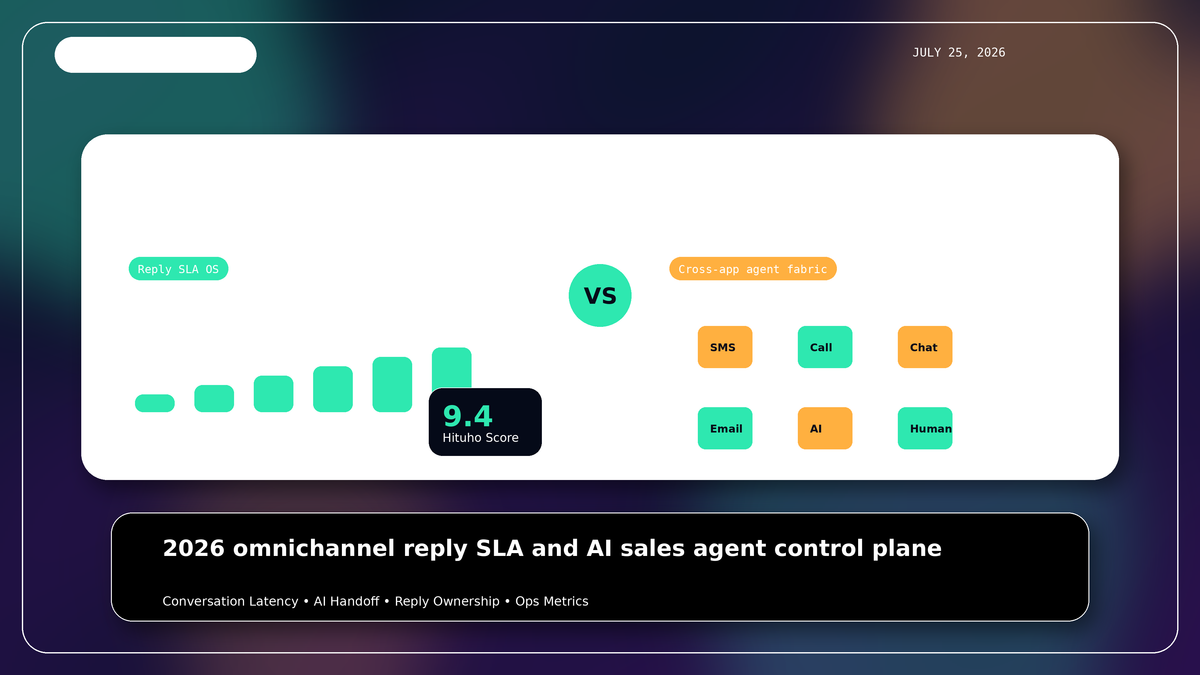
Bottom line: choose GoHighLevel when speed-to-lead, first response SLA, and AI-assisted sales follow-up must be owned by one revenue OS. Choose Zapier when reply quality depends on specialized AI models, ticket systems, CRMs, and internal ops tools that will never fully consolidate.
TL;DR for July 25, 2026: buyers no longer ask only whether automation can send a message. They ask who owns the thread, how fast the first useful reply lands, and whether AI can hand off without losing context.
What changed in 2026 conversation ops
Growth and sales teams now measure tools by reply latency, handoff quality, and closed-loop conversation ownership. A lead can arrive by form, ad click, missed call, SMS, chat widget, or email. The winning stack is the one that can score intent, draft a useful response, notify the right human, and keep the full thread auditable.
GoHighLevel compresses telephony, messaging, calendars, pipelines, and AI-assisted follow-up into one operator surface. Zapier acts as the orchestration fabric between inboxes, CRMs, support desks, model APIs, data stores, and internal alerts. Both can move events. Only one of them naturally owns the conversation.
Core model: conversation OS vs agent fabric
| Decision layer | GoHighLevel (July 2026) | Zapier (July 2026) |
|---|---|---|
| Conversation ownership | Native multi-channel inbox tied to contact and opportunity | Depends on connected inboxes, CRMs, or helpdesks |
| Reply SLA control | Workflow timers, AI drafts, assignment, and booking in one place | Latency depends on multi-step Zaps and destination systems |
| AI sales agents | Strong when agent actions stay close to CRM and messaging | Strong when many models, tools, and escalation apps must collaborate |
| Human handoff | Same timeline for bot, rep, notes, and next action | Excellent if handoff targets are explicit and monitored |
| Failure mode | Ecosystem lock-in and edge-channel gaps | Thread fragmentation and invisible automation sprawl |
When GoHighLevel wins the reply SLA game
GoHighLevel is the better default for agencies, local service businesses, coaches, and sales-led teams that need first response measured in minutes, not hours. The advantage is not just automation volume. It is that the same system sees the inbound event, conversation state, appointment status, and revenue stage.
- Speed-to-lead: trigger immediate SMS, AI draft, call queue, or calendar offer without multi-hop delay.
- Thread integrity: keep every channel interaction on one contact record so handoff does not require copy-paste archaeology.
- Sales context: let AI agents and humans see pipeline stage, tags, and prior objections before replying.
- Operator simplicity: one inbox, one workflow engine, one reporting surface for frontline teams.
- Agency replication: clone reply SLA patterns across client sub-accounts with less integration debt.
The tradeoff is clear: if your best support desk, product CRM, or model orchestration layer lives outside GoHighLevel, forcing every reply path into GHL can create awkward exceptions and dual inboxes.
When Zapier is the better AI agent fabric
Zapier is the better default when reply quality depends on modular intelligence. A modern agent path often looks like inbound event → enrichment → model classification → policy check → CRM update → draft reply → human approval → analytics writeback. Zapier is built for that multi-system pattern.
- Best-of-breed stacks: keep Salesforce, HubSpot, Intercom, Zendesk, Slack, Sheets, or internal tools without forced consolidation.
- Model flexibility: route different intents to different AI providers, prompts, or scoring services.
- Escalation design: branch by urgency, account value, language, or channel before a human is paged.
- Ops observability: inspect task history, retries, and ownership when agent paths cross teams.
- Incremental rollout: improve one channel or one scoring model without re-platforming the sales OS.
The risk is reply fog. If SMS lives in one tool, email in another, tickets in a third, and AI drafts in a fourth, nobody can prove who answered first or why the customer got two conflicting replies.
Practical comparison for operators
| Operator question | Prefer GoHighLevel | Prefer Zapier |
|---|---|---|
| Who owns the live thread? | Sales or agency team inside one conversation OS | Multiple teams and destination apps after first event |
| What must the AI agent do? | Reply, book, tag, and move pipeline stage near the contact | Classify, enrich, and orchestrate across many systems |
| How strict is the SLA? | Minutes matter and one owner must be accountable | Routing quality matters more than single-inbox speed |
| What fails first at scale? | Platform lock-in and niche-channel exceptions | Task cost, naming chaos, and dual replies |
| Best hybrid use | GHL as conversation and revenue OS | Zapier as enrichment and exception agent fabric |
A clean 2026 decision framework
Use three tests before buying more AI reply automation:
- First useful reply test: can a prospect get a correct, channel-native response fast enough to protect conversion?
- Handoff test: if AI fails, does a human inherit the full thread, intent score, and next action without rework?
- Collision test: if two automations fire on the same lead, who wins, who is suppressed, and who is notified?
If those three tests pass more easily inside one commercial OS, GoHighLevel is the answer. If they only pass when many specialized systems stay connected, Zapier is the answer.
Final recommendation
For July 25, 2026 buyers, GoHighLevel is the stronger choice when omnichannel reply SLA and AI-assisted sales follow-up need one owner. Zapier is the stronger choice when AI agents must reason across a modular stack before any message is sent.
Many mature operators run both with hard boundaries: GoHighLevel owns customer conversation execution; Zapier owns enrichment, niche model calls, and non-inbox ops. That hybrid only works when reply ownership is explicit and dual-send paths are banned.
Editorial disclosure: This article contains affiliate links. If you click and subscribe, Hituho may earn a commission at no extra cost to you. Recommendations are based on reply latency, handoff quality, ownership clarity, and practical operator value.